
5 Reasons Houstonians Choose Telehealth Counseling Texas

Houston traffic alone kills about 45 hours per year for the average commuter, according to the Texas A&M Transportation Institute. Now add a 50-minute therapy session to a Tuesday afternoon, and you begin to understand why telehealth counseling Texas has shifted from a pandemic workaround to a genuine first choice for thousands of Houstonians seeking mental health support. This is not about convenience for its own sake. It is about removing the real, practical barriers that keep people from getting help they actually need. Below are the five reasons licensed counselors at practices like Renewing Hope Counseling are seeing clients actively request online therapy over the traditional office visit.
Table of Contents
Quick Takeaways
Key Insight
Explanation
Houston commute time is a direct therapy barrier
The average round trip to a midtown Houston office can exceed 90 minutes, making weekly sessions unsustainable for many working adults and parents.
Online therapy Houston is legally equivalent to in-person care
Texas law allows fully licensed LPCs to provide telehealth services, meaning clients receive the same credentialed professional care without stepping into an office.
Reduced stigma is a documented benefit of virtual access
Clients who would avoid being seen entering a counseling office are significantly more likely to initiate and maintain treatment via a private home session.
Scheduling windows open up dramatically in telehealth formats
A virtual therapist Texas can offer early morning, late evening, or lunchtime slots that are impossible to fill when room availability limits the office schedule.
Research supports telehealth for anxiety, depression, and trauma
Multiple peer-reviewed studies show CBT and trauma-focused therapies delivered online produce outcomes equivalent to face-to-face delivery.
Faith-based integration is fully possible via telehealth
Clients who want faith-informed counseling are not limited by location when seeking a Houston practice that offers that approach remotely.
Children and teens often engage more openly on video
Many adolescents and children seen in play-therapy-adjacent formats are less guarded in their own environment, which can accelerate therapeutic progress.
Reason 1: No Commute Means No Delay in Getting Started
The single biggest reason people postpone mental health treatment is not cost or stigma. It is the friction of logistics. When a person is already managing anxiety or depression, adding a 45-minute drive through Houston's I-10 corridor is often the tipping point that converts a scheduled appointment into a cancellation.
In practice, the clients most likely to drop out of therapy after one or two sessions are those with the highest commute burden. Removing that friction with online therapy Houston keeps people engaged during the exact weeks when consistency matters most, which is the early phase of treatment when the therapeutic relationship is still forming.
Renewing Hope Counseling serves clients across the Houston metro, including areas like Katy, Sugar Land, and The Woodlands where a round trip to a central Houston office can realistically eat up two hours. For a working parent managing a child's anxiety or a professional navigating a major life transition, those two hours are not recoverable. Telehealth gives them back.
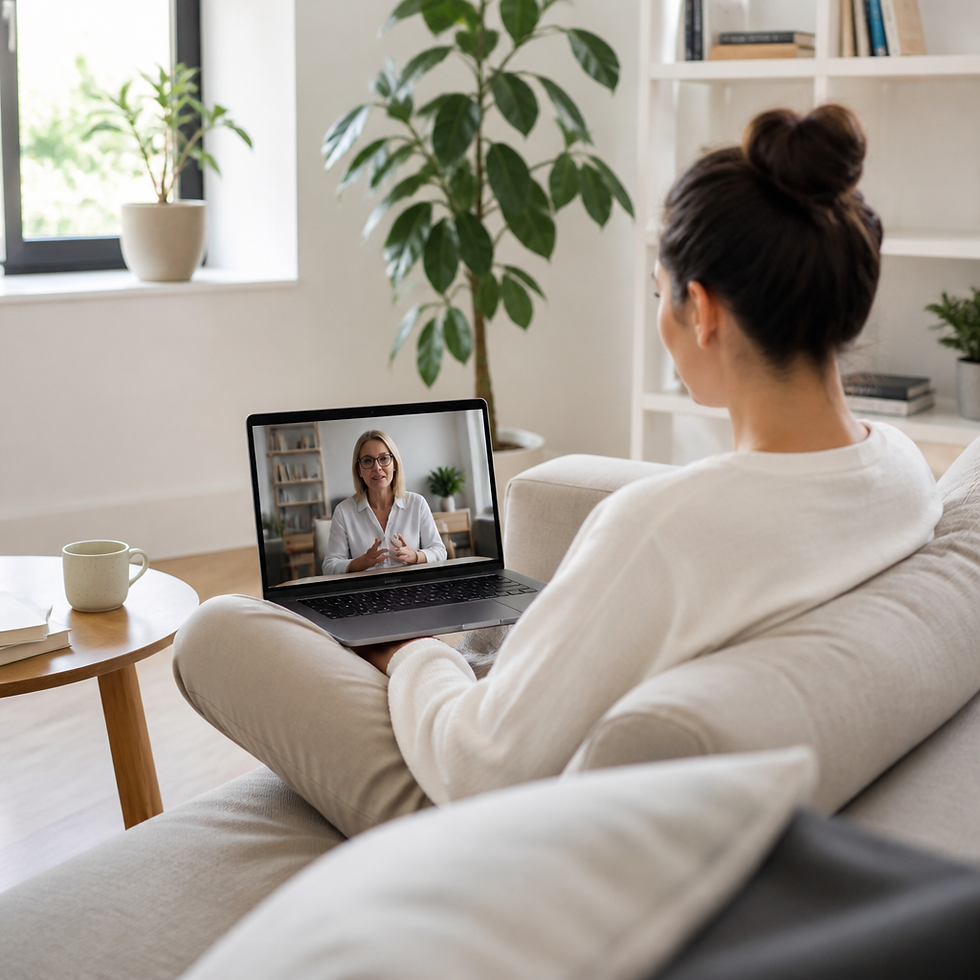

Pro tip: If you are new to telehealth and worried about technical setup, most licensed counseling practices in Texas use HIPAA-compliant platforms that require nothing more than a smartphone or laptop. Ask your provider during the intake call and they will walk you through it in under five minutes.
Reason 2: Houston's Geography Is a Real Barrier to In-Person Care
Houston is the fourth largest city in the United States by population and covers over 670 square miles. That physical sprawl creates a direct mental health access problem. A therapist who is geographically ideal on paper may be 35 miles away by road, which in Houston rush hour translates to 60 or more minutes of driving one way.
Underserved suburbs need licensed support without the drive
Communities like Humble, Pearland, Cypress, and Missouri City often have fewer licensed mental health providers per capita than the inner loop. When a licensed professional counselor in Houston can see clients across the entire state via telehealth, the geographic constraint dissolves. A family in Pearland dealing with grief after a loss can access the same quality of evidenced-based therapeutic care as a client blocks from the Galleria.
Harris County's size makes specialty matching harder in person
Finding a therapist who specializes in, say, trauma-focused care and also integrates faith-based approaches is hard enough. Finding one within a 15-minute drive of your zip code is statistically unlikely. Virtual therapist Texas options let clients prioritize clinical fit over map distance, which is the correct priority for therapeutic outcomes.
"Access to mental health care is not just about whether services exist. It is about whether people can realistically reach them." - Substance Abuse and Mental Health Services Administration (SAMHSA), 2023 National Survey on Drug Use and Health
Reason 3: Greater Privacy Reduces Stigma-Related Avoidance
Mental health stigma in Houston, as in most major American cities, is real and unevenly distributed. Certain professional industries, cultural communities, and family systems carry strong implicit messages that seeking counseling is a sign of weakness or failure. The data consistently shows that stigma is the number one self-reported reason people delay or avoid mental health treatment entirely.
Telehealth addresses this directly. A client does not have to park their car in front of a counseling office building where a colleague, neighbor, or church acquaintance might see them. They log in from a private room at home, and the session stays completely contained. For clients navigating trauma, marital difficulties, or depression they have not disclosed to anyone, that privacy is not a minor perk. It is the reason they are willing to show up at all.
Pro tip: When starting online therapy from home, designate a consistent, private space for your sessions. Even a bedroom with the door closed and a white noise app running in the hallway creates enough separation for a therapeutically productive hour. Consistency in physical setting also helps your brain shift into a therapy-ready mindset faster over time.
Renewing Hope Counseling's approach to compassionate, non-judgmental care translates naturally to a telehealth format because the therapeutic relationship depends on what the counselor offers, not where the client sits. For individuals who want to integrate their faith into counseling but feel self-conscious about discussing spirituality with someone face-to-face for the first time, the relative comfort of their own home can lower the initial guard significantly.

Reason 4: Scheduling Flexibility That Matches Real Houston Lives
Traditional office therapy operates within a narrow scheduling window. Most practices run sessions from roughly 9 AM to 6 PM on weekdays, bounded by office space availability and administrative overhead. That window excludes a large portion of working Houstonians, shift workers in the medical center or energy sector, and parents whose schedules are dictated by school pickup times.
Early morning and late evening slots become viable
A licensed counselor working via telehealth does not need to be physically present in an office. This means a 7 AM session before a client's shift at a hospital in the Texas Medical Center is possible. A 7:30 PM session after children are in bed is possible. These are not edge cases. They are the scheduling reality for a significant portion of Houston's working population.
Couples and family sessions benefit from reduced coordination friction
For couples therapy, telehealth removes the logistical challenge of both partners driving from different locations to meet at a central office at an agreed time. Each partner can join from wherever they are, which also reduces the pre-session tension that sometimes comes from commuting together to an appointment both may be anxious about. Family counseling, including sessions involving teens, benefits similarly when participants can join from school or work before regrouping at home.
Renewing Hope Counseling offers services for individuals, couples, teens, and families, and the scheduling flexibility of telehealth makes it meaningfully easier to book and keep appointments across all of those service types.
Reason 5: The Clinical Outcomes Are Comparable or Better
This is where the skepticism usually lives. People assume that therapy done through a screen must be less effective than therapy done in person. The research does not support that assumption. A 2021 meta-analysis published in the journal Psychological Medicine found that internet-delivered cognitive behavioral therapy produced outcomes statistically equivalent to face-to-face CBT for anxiety and depression.
Trauma treatment via telehealth has strong evidence
Trauma-focused therapies including Prolonged Exposure and CPT have been studied in telehealth formats specifically. Research from the VA system, which conducted some of the most rigorous telehealth therapy studies during and after COVID-19, showed that veterans receiving PTSD treatment via video showed comparable reductions in symptom severity to those seen in office. This matters for Houston clients dealing with trauma because it means they are not accepting a lesser standard of care when they choose a virtual therapist Texas.
Therapeutic alliance forms effectively online
A common clinical concern is that the therapeutic relationship, the alliance between client and counselor that research identifies as the strongest predictor of positive outcomes, cannot form as readily through a screen. In practice, this concern is often overstated. Clients who feel safe, heard, and understood by their counselor build that alliance regardless of medium. What matters most is the counselor's clinical skill and empathy, both of which travel perfectly well through a broadband connection.
For children receiving play therapy-adjacent services, the calculus is slightly different. Hands-on modalities require adaptation in a telehealth environment. A skilled counselor adjusts techniques to work within the child's home environment, sometimes using the child's own toys and familiar space as therapeutic tools, which has its own distinct advantages in child counseling contexts.
Telehealth vs. In-Person vs. Hybrid Therapy: A Side-by-Side Look
Choosing the right format depends on your specific situation. Here is how the three main delivery formats compare across the factors Houstonians most consistently raise:
Factor
Telehealth (Online Only)
In-Person (Office Only)
Hybrid (Mix of Both)
Commute requirement
None. Session from any private location in Texas.
Full commute required every session.
Reduced. Commute only for selected in-person sessions.
Privacy for stigma-sensitive clients
Highest. No public visibility entering a counseling office.
Lower. Requires physical presence at a visible location.
Moderate. Some sessions remain visible.
Scheduling flexibility
Highest. Early, evening, and lunchtime slots viable.
Limited by office hours and room availability.
Moderate. More flexible than full in-person.
Clinical effectiveness for anxiety and depression
Equivalent to in-person per peer-reviewed research.
Strong evidence base as the traditional standard.
No evidence it outperforms either format alone.
Suitability for young children in play therapy
Requires adaptation. Works best with parental co-participation.
Optimal for structured play therapy modalities.
Best option for child clients who need some in-person time.
Coverage across Texas geography
Full. Any licensed Texas LPC can serve any Texas resident.
Limited to clients within practical driving distance.
Limited. In-person component still requires proximity.
Frequently Asked Questions
Is telehealth counseling in Texas legally the same as in-person therapy?
Yes. Texas law explicitly allows licensed professional counselors to provide services via telehealth to any client physically located in Texas at the time of the session. The licensure, ethical obligations, and HIPAA protections are identical to in-person care. You are receiving care from the same credentialed professional under the same legal framework.
Can I use insurance for online therapy in Houston?
Most major insurance plans now cover telehealth mental health services at parity with in-person visits following federal and state parity legislation. The best step is to contact your insurance provider directly and confirm telehealth behavioral health coverage before your first session. Reputable practices like Renewing Hope Counseling can also help you verify benefits during the intake process.
What technology do I need for a telehealth counseling session?
You need a device with a functioning camera and microphone, a stable internet connection, and a private space. A smartphone, tablet, or laptop all work. Providers use HIPAA-compliant video platforms, and most require no software downloads beyond opening a secure link. If technology concerns are holding you back from starting, ask the practice to walk you through setup during a brief pre-session call.
Is telehealth appropriate for trauma therapy, or do I need in-person sessions?
Telehealth is appropriate for most trauma-focused therapies. Evidence-based approaches like Cognitive Processing Therapy and trauma-focused CBT have been studied extensively in telehealth formats with outcomes comparable to in-person delivery. That said, if a client is in active crisis or requires grounding techniques that need physical co-regulation, a clinician may recommend in-person or hybrid care. This is a clinical decision your counselor will make with you based on your specific situation.
Can couples therapy work over telehealth if we are both home together?
Yes, and it works well. Many couples find the familiar home environment actually reduces the performative quality that sometimes appears in a formal office setting. The counselor manages the session structure just as they would in person. Some couples choose to sit together on camera, while others join from separate rooms or devices if the session calls for individual reflection. Your counselor will guide the format based on the therapeutic goals for that session.
Does Renewing Hope Counseling offer telehealth for children and teens?
Renewing Hope Counseling serves children, teens, and families, and telehealth formats can be adapted for younger clients. Play therapy techniques are modified for the home environment, often involving the child's own familiar toys and space. For very young children requiring hands-on modalities, a hybrid or in-person approach may be recommended. This is assessed during the initial intake based on the child's age, presenting concerns, and family situation.
Have you tried telehealth counseling in Texas and found it changed how you think about mental health care? Share your experience or questions in the comments below so others navigating the same decision can benefit from what you learned.


Comments