
ADHD Assessment Houston: What to Expect and Why It Matters
- Brent Dyer

- Jun 13
- 10 min read
Most adults and parents who suspect ADHD have already spent months, sometimes years, wondering whether what they are experiencing is real. They have read checklists online, talked to teachers or partners, and still do not have a clear answer. An ADHD assessment Houston provides that answer with clinical precision, not guesswork. According to the CDC, approximately 9.4% of children and 4.4% of adults in the United States have been diagnosed with ADHD, yet many cases go undetected because a proper evaluation was never completed. This article explains exactly what a professional ADHD evaluation involves, why it matters more than a quick screening, and how to move forward if you are in Houston and ready for answers.
Table of Contents
Quick Takeaways
Key Insight
Explanation
An ADHD assessment is not a single test
It involves clinical interviews, standardized rating scales, and often cognitive testing conducted across multiple sessions.
Online ADHD quizzes do not constitute a diagnosis
Screening tools flag symptoms but cannot rule out anxiety, depression, or trauma, all of which mimic ADHD closely.
Houston adults are underdiagnosed
Many adults managing anxiety or chronic disorganization in Houston have never been evaluated for ADHD because they were high-functioning in school.
A learning assessment is often paired with ADHD evaluation
Identifying co-occurring learning disabilities like dyslexia requires separate cognitive and academic achievement testing.
Diagnosis opens access to real support
A formal diagnosis qualifies children for school accommodations under a 504 plan or IEP, and adults for workplace accommodations.
ADHD frequently co-occurs with anxiety and depression
A thorough evaluation distinguishes primary ADHD from emotional dysregulation caused by untreated mood disorders.
Counseling after diagnosis is not optional, it is recommended
Medication alone does not address the emotional and relational patterns built up over years of living with undiagnosed ADHD.
What Is an ADHD Assessment and Who Needs One
An ADHD assessment is a structured clinical process designed to determine whether a person meets diagnostic criteria for Attention-Deficit/Hyperactivity Disorder as defined in the DSM-5. It is not a personality quiz, and it is not something a pediatrician can fully complete in a 15-minute wellness visit. A proper evaluation requires time, multiple data sources, and a trained clinician who knows what they are looking for.
People who benefit most from a formal ADHD evaluation Houston include children whose teachers have raised concerns about attention or behavior, teens struggling academically despite obvious intelligence, adults who have never been able to sustain focus at work, and parents who recognize their own patterns in their child's diagnosis. It is also appropriate for anyone whose anxiety or depression has not responded well to treatment, because undiagnosed ADHD is frequently the underlying driver.
A common mistake is assuming that because a person is organized in some areas of life, they cannot have ADHD. In practice, high-achieving individuals often develop elaborate compensation strategies that mask symptoms for years. The evaluation process is designed to look past those compensations and assess what is actually happening neurologically.
Pro tip: If you are a parent who was told your child is "just bright and bored" but the struggles continue, push for a comprehensive evaluation rather than accepting reassurance without data. A formal assessment either confirms or rules out ADHD with evidence, not assumptions.

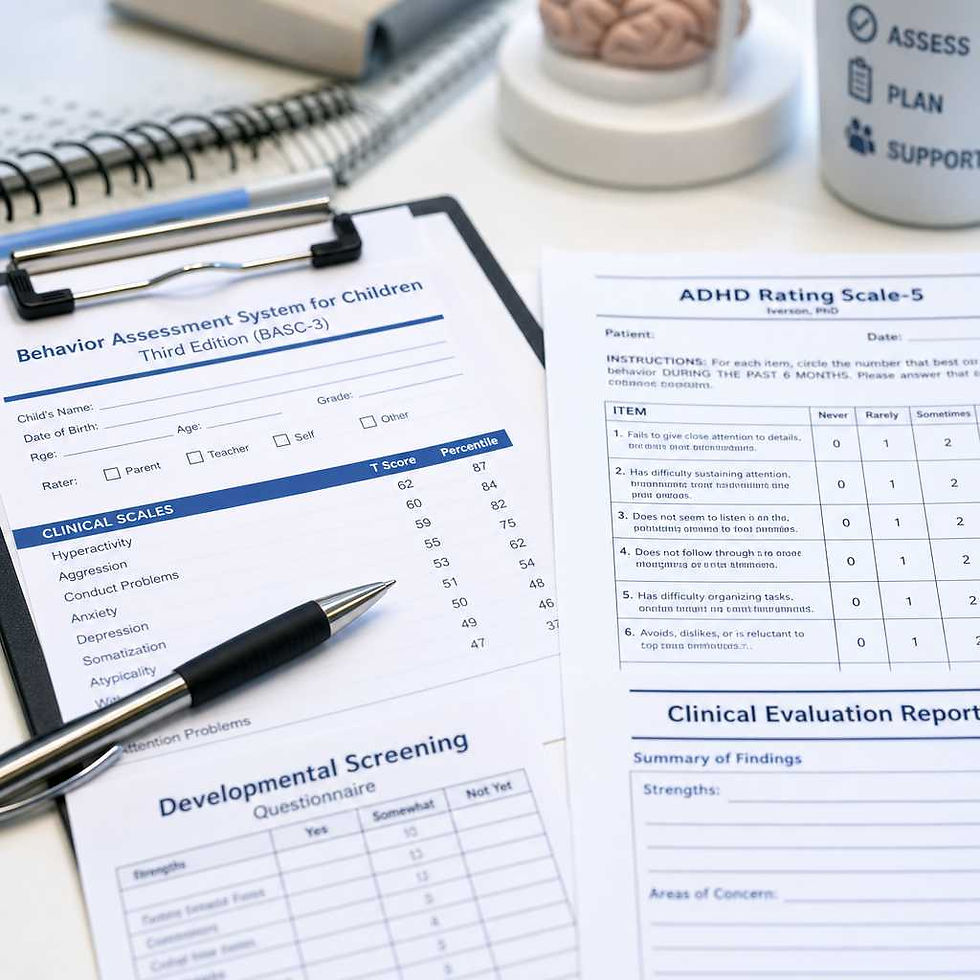
What Happens During an ADHD Evaluation in Houston
The process for a complete ADHD evaluation typically unfolds across two to three sessions. Here is what each phase involves, and why each piece matters.
Clinical Interview
The first session is a structured clinical interview. For children, this means the clinician meets with the parents to gather a detailed developmental history: pregnancy and birth, early milestones, school history, behavior patterns at home, and any previous mental health treatment. For adults, the interview covers childhood experiences, academic history, current work and relationship challenges, and symptom onset. The DSM-5 requires that symptoms be present before age 12, so historical context is essential.
Standardized Rating Scales
Clinicians use validated rating scales such as the Conners Rating Scales, the Vanderbilt Assessment, or the Brown Attention Deficit Disorder Scales to gather behavioral data from multiple informants. For children, this means parents and teachers complete separate forms. For adults, a partner or close colleague may be asked to provide input. This multi-informant approach matters because ADHD symptoms often look different in different environments, and self-report alone is not sufficient for an accurate diagnosis.
Review of Records
School records, report cards, previous psychological evaluations, and medical records all inform the diagnostic picture. A pattern of teacher comments like "does not finish work" or "easily distracted" appearing across multiple grade levels is clinically meaningful data. In practice, many Houston families come to an evaluation without these records, and gathering them can extend the timeline by a week or two.
Cognitive and Neuropsychological Testing
When a learning assessment Houston is also needed, the evaluation includes standardized cognitive testing such as the WISC-V for children or the WAIS-IV for adults, along with academic achievement measures like the Woodcock-Johnson. These tests measure processing speed, working memory, verbal comprehension, and perceptual reasoning. They help identify whether attention difficulties are part of ADHD, a learning disability, or both. This phase typically takes two to four hours of direct testing time.
Learning Assessment and ADHD: Understanding the Overlap
ADHD and learning disabilities are not the same thing, but they frequently occur together. Research published by the National Institute of Mental Health indicates that up to 50% of children with ADHD also have a co-occurring learning disability. This means a standard ADHD evaluation that only measures attention and behavior will miss half the picture for many Houston families.
A full learning assessment Houston goes beyond checking for ADHD. It identifies specific learning disabilities in reading (dyslexia), written expression (dysgraphia), or mathematics (dyscalculia). It also measures intellectual functioning to determine whether academic struggles are related to cognitive ability, learning differences, attention, emotional factors, or some combination of all four.
"The goal of a comprehensive evaluation is not just to label a child. It is to map their cognitive strengths and weaknesses so that every intervention, every classroom accommodation, and every therapeutic strategy is built on accurate information." - American Psychological Association, Division 16 (School Psychology)
For Houston families navigating the Houston Independent School District or other local districts, a formal learning and ADHD assessment report from a licensed professional carries significant weight when requesting a 504 plan or an Individualized Education Program. School-based evaluations are available at no cost, but they are often narrower in scope and take longer to complete than private assessments.
Pro tip: Request a copy of the full written report from any evaluation you complete privately. It should include raw test scores, percentile rankings, diagnostic impressions, and specific recommendations. A report that only gives you a diagnosis without actionable recommendations is incomplete.

Comparison of ADHD Assessment Approaches
Not all ADHD evaluations are created equal. Houston families often choose between a brief clinical screening, a standard psychological evaluation, and a full neuropsychological assessment. Here is how those three approaches compare on the dimensions that matter most.
Assessment Type
What It Includes
Best For
Brief Clinical Screening
Standardized rating scales, short clinical interview, no cognitive testing. Often completed by a pediatrician or psychiatrist.
Initial triage or when the clinical picture is clear and uncomplicated. Not sufficient for school accommodations in most Houston ISD districts.
Standard Psychological Evaluation
Clinical interview, multiple rating scales, cognitive testing (IQ and achievement measures), written report with recommendations.
Children and adults needing documentation for school accommodations, workplace accommodations, or a clearer diagnostic picture when symptoms are complex.
Full Neuropsychological Assessment
All of the above plus extensive memory, executive function, processing speed, and language testing. Typically 6-10 hours of testing across multiple sessions.
Complex cases involving possible traumatic brain injury, suspected multiple co-occurring conditions, or when prior evaluations have produced conflicting results.
The data consistently shows that underinvesting in the evaluation phase leads to misdiagnosis or missed co-occurring conditions. A standard psychological evaluation completed by a licensed professional is the appropriate starting point for most Houston families and adults seeking clarity.
ADHD in Children vs. Adults: How Assessments Differ
The same diagnostic criteria apply regardless of age, but the way ADHD presents, and therefore the way it is assessed, changes significantly between childhood and adulthood.
ADHD Assessment for Children in Houston
For children, hyperactivity is often the most visible symptom. Teachers notice it first. Parents see it at home during homework. The evaluation process relies heavily on parent and teacher rating scales because children do not yet have the self-awareness to accurately report their own symptoms. Play-based observation can also be part of the process for younger children, particularly those under age eight. Children's counseling contexts at a practice like Renewing Hope use play therapy approaches that complement the formal assessment process by providing behavioral observation in a naturalistic setting.
ADHD Assessment for Adults in Houston
Adult ADHD presentations are frequently subtler. Hyperactivity often shifts to internal restlessness, chronic procrastination, and difficulty with sustained reading or complex projects. Many Houston adults seeking an evaluation have already been treated for anxiety or depression for years without significant improvement, and a clinician with ADHD expertise recognizes this pattern immediately. Adult evaluations depend more on self-report and collateral interviews with partners or colleagues, and they require a careful review of whether current symptoms can be better explained by mood disorders, sleep disorders, or chronic stress.
The overlap between ADHD and anxiety is particularly tricky in adult evaluations. Both conditions impair concentration, but the mechanism is different. Anxiety disrupts attention through worry and avoidance. ADHD disrupts attention through deficits in executive function and dopamine regulation. Getting this distinction right determines whether treatment leads to genuine improvement or continued frustration.
After the Diagnosis: What Comes Next
A diagnosis without a clear treatment plan is just a label. The real value of an ADHD assessment emerges in what comes after the evaluation is complete.
Therapy as a First-Line Response
For children under age six, behavioral therapy is recommended as the first line of treatment before any medication is considered, per guidelines from the American Academy of Pediatrics. For older children and adults, therapy combined with medication consistently outperforms either approach alone. Evidence-based modalities that directly address ADHD include Cognitive Behavioral Therapy adapted for ADHD, executive function coaching, and family systems therapy that helps everyone in the household adjust their expectations and communication patterns.
At Renewing Hope Counseling in Houston, individual counseling, family counseling, and children's counseling services are designed to address exactly the kind of relational and emotional fallout that builds up in families where ADHD has gone unidentified for years. Couples therapy is also relevant when one partner's ADHD has created chronic frustration and communication breakdown in the relationship.
School and Workplace Accommodations
A formal written report from a licensed evaluator is required documentation for most Houston ISD schools when requesting a 504 plan or IEP. Common accommodations that make a measurable difference include extended test time, preferential seating, reduced distraction testing environments, and modified homework expectations. For adults, workplace accommodations under the Americans with Disabilities Act may include flexible scheduling, private workspace, or written instructions for complex tasks.
When Faith Matters to the Family
Some Houston families want their post-diagnosis support to integrate their faith. Renewing Hope Counseling offers faith-based counseling approaches for individuals and families who want their therapeutic process to be consistent with their spiritual values. This is not a replacement for evidence-based treatment. It is a complementary dimension that many clients find meaningful in making sense of a new diagnosis within the larger context of their lives.
Frequently Asked Questions
How long does an ADHD assessment in Houston take?
A standard ADHD evaluation typically involves two to three appointments totaling four to six hours of clinical time. If cognitive testing for a learning assessment is included, add another two to four hours of direct testing. The full written report is usually ready within one to two weeks after testing is complete.
Can a therapist diagnose ADHD in Texas?
In Texas, Licensed Professional Counselors can conduct clinical interviews and administer behavioral rating scales, but a formal ADHD diagnosis that includes cognitive testing and a written neuropsychological or psychological report is typically conducted by a licensed psychologist or a Licensed Specialist in School Psychology. Some practices work collaboratively, with a psychologist completing the formal assessment and a licensed counselor providing ongoing therapy. Always ask about the credentials of the person completing your evaluation.
What is the difference between an ADHD screening and a full ADHD evaluation?
A screening uses a brief checklist or rating scale to flag whether ADHD symptoms are present at a clinically significant level. It takes 10 to 20 minutes and produces a score, not a diagnosis. A full evaluation integrates clinical interview data, multi-informant rating scales, record review, and often cognitive testing to arrive at a diagnosis that accounts for all possible explanations of the symptoms. The evaluation is what you need for school accommodations, a medication referral, or a clear clinical picture.
Does insurance cover ADHD assessments in Houston?
Coverage varies significantly by insurance plan and provider. Some Houston insurance plans cover psychological testing when it is medically necessary, while others treat it as an out-of-pocket expense. It is worth calling your insurance provider directly and asking about coverage for CPT codes 96136 and 96137, which are the standard codes for psychological testing administration and scoring. Many families find that even when insurance does not cover the full evaluation cost, the one-time investment is worth the years of clarity and targeted support it provides.
My child was already evaluated at school. Do they need another assessment?
School-based evaluations are designed to determine eligibility for special education services under IDEA, not to provide a comprehensive clinical diagnosis. They are narrower in scope and are conducted by school psychologists whose primary job is eligibility determination, not clinical diagnosis. A private evaluation through a licensed psychologist or counseling practice provides a fuller diagnostic picture, is valid outside the school context for medical and therapeutic purposes, and typically includes more detailed recommendations for treatment and support.
Can ADHD be diagnosed in adults who were never identified as children?
Yes, and this is more common than most people realize. Many adults currently in Houston managing what they believe is chronic anxiety, career instability, or relationship conflict have undiagnosed ADHD. The DSM-5 requires that symptoms were present before age 12, but this does not mean they were diagnosed then. A thorough adult evaluation reviews childhood history through self-report, family recollection, and any available records to establish the developmental timeline. Late diagnosis in adults frequently produces significant relief and opens access to effective treatment options.
Have you or someone in your family gone through an ADHD assessment in Houston? We would love to hear what the process was like and what made the biggest difference for your family.


